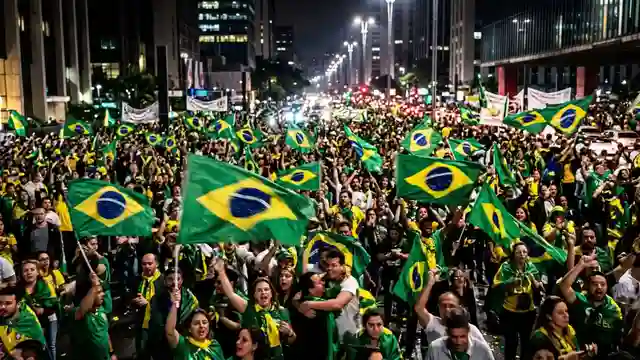

Brazil has delivered the political shock of the year: an 80-year-old president written off by almost everyone won a historic fourth term, and the man he beat is refusing to accept the result. Luiz Inácio Lula da Silva defeated Senator Flávio Bolsonaro in Sunday’s runoff with 51.8 percent of the vote, a comeback from a first-round defeat no Brazilian candidate had ever survived, while the defeated candidate, the eldest son of the jailed former president Jair Bolsonaro, called for the entire election to be annulled. Financial markets convulsed, world leaders queued up to congratulate the winner, and Latin America’s biggest country now heads into a standoff between the ballot box and the courts. Here is the full picture: the exact numbers, the legal fight, the market meltdown, and what happens next.
The Result in Numbers: How Lula Won a Fourth Term
Direct answer: with 100 percent of ballots counted, Brazil’s Superior Electoral Court put Lula at 64,256,232 votes (51.79 percent) against 59,826,041 (48.21 percent) for Flávio Bolsonaro, a winning margin of nearly 4.4 million votes.
Three things make the numbers historic rather than merely comfortable. First, the comeback: Lula had lost the first round to Bolsonaro earlier this month, and no candidate in Brazilian history had ever lost the opening round and then won the runoff, a barrier the 80-year-old dismantled by adding at least ten million votes to his first-round total. Second, the margin: about double his razor-thin victory over the candidate’s father four years ago, a result built on record turnout and a campaign dominated by the cost of living. Third, the milestone: a fourth presidential term puts Lula in territory no Brazilian has reached, completing one of the most improbable resurrections in modern democratic politics, from prison-less, written-off elder statesman to the first leftist in years to stop Latin America’s rightward march.
Lula framed the win in those exact terms, calling it a “defeat for denialism” and vowing from the victory stage that there will be “no return to dictatorship,” a line aimed directly at the family he has now beaten twice. World leaders from Europe and across the region congratulated him within hours, a gesture that doubled as a bet on Brazil’s stability at a nervous moment.
Why Bolsonaro Rejects the Result: The Two-Hour Extension Fight
The refusal to concede rests on a single decision, and it unfolded at breakneck speed. Three minutes before polls were due to close on Sunday evening, Supreme Court Justice Cristiano Zanin ordered voting extended by two hours nationwide, acting on a request from Lula’s campaign, which alleged that public officials had deliberately slowed public transport in São Paulo and Salvador, cities that favour the incumbent, to suppress turnout. The polls stayed open, the votes flowed, and by the early hours the electoral court had declared Lula the winner.
Flávio Bolsonaro’s case is that rules cannot be changed mid-election. “It is impossible to recognize the election result given how these events unfolded,” he told supporters in Brasília, announcing his legal team would “ask for this election to be annulled.” In his telling, the extension was not a voting-rights remedy but a late manipulation that harvested extra votes for his opponent. Election law specialists note that annulment requires proving the irregularity changed the outcome, a steep bar in a 4.4-million-vote margin, and Brazil’s electoral court certified the result with all ballots counted. The echo of history is impossible to miss: four years ago the candidate’s father, Jair Bolsonaro, also refused to accept defeat to Lula, then went further, an attempt to overturn the result that ended in criminal conviction and prison. This time, notably, the institutional response has been faster: within a day, Flávio Bolsonaro’s own Liberal Party acknowledged the election outcome in a statement, even as the senator pursued his legal challenge.
Who Is Flávio Bolsonaro? The Son Who Carried the Flag
The man at the centre of the challenge is 45, a senator, and the eldest son of Brazil’s most divisive modern politician. Flávio Bolsonaro entered the Senate in 2019 and has long been considered the political heir of the Bolsonaro movement, stepping forward this year because his father, the former president Jair Bolsonaro, was barred from running and stands convicted for his role in the coup attempt that followed the 2022 election he lost to Lula by the narrowest margin in Brazilian history.
Flávio positioned himself as the Trump-aligned candidate in the race, courting support from Washington’s conservative circle, and he rode a genuine wave: seven consecutive right-wing presidential victories had swept Latin America, Brazil’s economy was straining under global fuel and food prices, and prediction markets had all but declared him the winner. As late as Sunday evening, Kalshi traders gave Lula just a 21 percent chance of victory. The runoff result flipped that consensus overnight, which is precisely why the shock, in markets and in the movement, has been so severe.
How Election Night Unfolded, Minute by Minute
The sequence matters for the legal fight, so it is worth reconstructing. Polls were scheduled to close across Brazil at 5 p.m. Brasília time on Sunday, with results expected within hours under the country’s fully electronic voting system. Instead, minutes before closing, Justice Cristiano Zanin of the Supreme Federal Tribunal granted an emergency request from the Lula campaign: voting would stay open two extra hours nationwide, on allegations that bus and metro services had been deliberately throttled in São Paulo and Salvador to strand would-be voters, a form of suppression both cities’ governments denied but that witness footage put in circulation all afternoon.
The extension turned a routine evening into chaos. Television networks delayed their projections, queues stretched past midnight in some precincts, and the first substantial count arrived close to midnight local time, showing Lula with a lead that only grew as the final ballots, many of them cast in the extended window, were tallied. By 1 a.m. the electoral court’s numbers had him past the 50 percent line that decides runoffs outright, and officials declared the result with every machine reported. Flávio Bolsonaro took the stage in Brasília minutes later, refusing concession, and the annulment announcement came before dawn. The speed of it all, from closed polls to contested presidency in under ten hours, is why markets moved in premarket trading rather than over a weekend, and why the courts face immediate pressure to rule.
Markets Rocked: The 25 Percent Plunge
The financial reaction told the story the polls missed. The iShares MSCI Brazil exchange-traded fund, the main vehicle through which global investors hold Brazilian assets, fell 25 percent in premarket trading on Monday after the result, one of the sharpest single-day moves for a major country fund in years. Investors had priced in a Bolsonaro victory and were blindsided, with Brazilian stocks and the currency caught in the same downdraft as trading opened in New York.
The logic behind the panic is about economic policy, not personality. Markets had favoured Flávio Bolsonaro on expectations of continued fiscal restraint and market-friendly appointments, while a fourth Lula term raises questions about public spending, state intervention and the fiscal framework that will define his new mandate. The coming days will show whether the sell-off stabilises as investors digest the result, the annulment attempt’s slim legal prospects, and the fact that Lula’s previous terms, whatever their politics, coincided with a commodity boom that global investors still remember. For emerging-market watchers, and for readers tracking how politics moves money, the Brazil lesson of the week is blunt: prediction markets are opinions with prices attached, and Sunday evening proved they can be 79 points wrong.
What Lula’s Win Means for the Region and the World
The New York Times captured the regional stakes precisely: Lula’s victory ended a string of seven consecutive right-wing presidential wins across Latin America, delivering the first major setback to the conservative surge that has reshaped the continent and that Washington’s current administration has openly encouraged. Brazil, as Latin America’s largest country and economy, is the prize that changes the map, and Lula’s win restores a counterweight to American influence in the hemisphere at the exact moment the region is being pulled into Washington’s orbit on tariffs, migration and the Iran confrontation.
President Trump commented on the Brazilian result on Monday alongside other news of the day, and the broader White House reaction is being watched closely, given the tariff and political pressures the two capitals have exchanged this year. For the wider world, the deeper signal is institutional: Brazil’s courts extended voting hours to protect access, its electoral court certified the result with full transparency, and even the rejecting party’s statement acknowledged the outcome within a day. The system bent, argued loudly, and held, which is more than could be said for the same country four years ago. Our coverage of the global pressure points that shaped this election year continues with the US midterms eight days away and the oil-price shock squeezing economies on every continent, Brazil’s fuel bills very much included.
What Happens Next: The Calendar
Frequently Asked Questions
Who won the Brazil election 2026?
President Luiz Inácio Lula da Silva won the October runoff with 51.79 percent of the vote to Senator Flávio Bolsonaro’s 48.21 percent, a margin of about 4.4 million votes, securing a historic fourth term.
Why did Bolsonaro reject the result?
A Supreme Court justice ordered voting extended by two hours three minutes before polls closed, acting on Lula campaign claims of transport sabotage. Flávio Bolsonaro calls the late rule change foul play and has asked for the election to be annulled, though his party acknowledged the result the next day.
Can the Brazilian election be annulled?
The challenge faces very long odds. Annulment requires proving the extension changed the outcome, and the margin is 4.4 million votes. The electoral court has certified the result with 100 percent of ballots counted.
Which Bolsonaro lost, and where is the father?
Flávio Bolsonaro, 45, the eldest son of former president Jair Bolsonaro, was the candidate. His father is barred from office and was convicted for the coup attempt that followed his 2022 defeat, which is why the son carried the family’s banner this year.
Why did Brazilian markets crash?
Investors had strongly expected a Bolsonaro win; the main Brazil ETF fell 25 percent in Monday premarket trading as positions unwound. Concerns centre on spending and fiscal policy under a fourth Lula term.
When does Lula take office?
The new term begins January 1, 2027, following the standard transition, assuming the courts reject the annulment attempt as expected.
Full election data is published by Brazil’s electoral authority, and official presidential information is available on the Planalto presidency website. This report is maintained by the blazinginfo.com world desk and updated as the legal challenge develops. Results follow the certified count of Brazil’s Superior Electoral Court as reported by international wire services. Do you think the two-hour extension justifies a challenge, or is this 2022 all over again? Give us your take in the comments.


