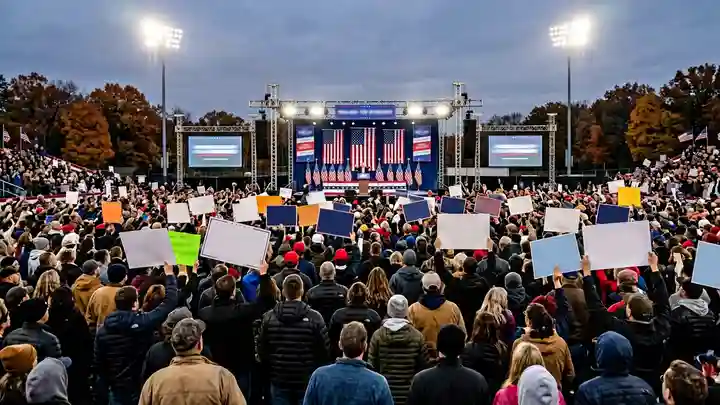

America’s midterm campaign has produced its most explosive controversy yet, and it centres on a Muslim doctor running for the United States Senate. At a rally in Port Huron, Michigan on Sunday, President Donald Trump called Democratic candidate Abdul El-Sayed a “jihadist”, suggested he would need a metal detector to enter the Senate, and invoked the September 11 attacks in urging voters to reject him. The remarks drew an extraordinary rebuke from Bishara Bahbah, a founder of the very Arab American coalition that campaigned for Trump in 2024, who called the president’s comments racist. With eight days until Election Day and Michigan’s Senate seat among the handful that will decide control of the chamber, this guide explains exactly what was said, who Abdul El-Sayed is, how the race stands, and why the story is being followed far beyond Michigan.
What Trump Said at the Port Huron Rally
Direct answer: speaking to roughly 4,000 supporters in Port Huron, a waterfront city an hour north of Detroit, Trump framed his trip as a mission against one candidate, declaring “I’m here to keep a jihadist Muslim Brotherhood member from becoming a United States senator.”
The specific lines matter because each has now been quoted across the world’s press. Trump called El-Sayed “on the side of the terrorists” and said anyone with such a record “should not give him a seat in the United States Senate.” He promised: “He would be the only senator that will have to go through a metal detector before he’s allowed to go into the Senate. I want him to have a metal detector.” He brought on stage the father of a passenger who fought back against the hijackers on United Flight 93, drawing a direct parallel between stopping El-Sayed and the passengers of September 11. And he stretched the warning into apocalyptic territory: “If Abdul and the Democrats win, they will open the floodgates and invite hordes of jihadists to our shores, creating a nightmare of violence and terror until you cannot even have a Christmas.”
Trump also repeatedly referred to the candidate by his middle name, Mohamed, misrepresenting his name in the way critics read as deliberate. The rally extended to another Muslim lawmaker, with Trump attacking Democratic Representative Ilhan Omar of Minnesota in the same appearance. Throughout, he offered no evidence for the extremism allegations, and none exists: El-Sayed is a US-born citizen who has pledged to uphold the Constitution and has repeatedly denied any tie to extremist organisations.
Who Is Abdul El-Sayed? The Man at the Centre of the Storm
Direct answer: Abdulrahman Mohamed El-Sayed, known as Abdul, is a US-born physician and epidemiologist, a former Detroit health commissioner and Michigan state health director, and the Democratic nominee who would become the first Muslim United States senator in history if elected on November 3.
The biography explains both the attacks and the attention. El-Sayed was born in New Jersey, the son of Egyptian immigrants, and built a career that sits squarely in the American mainstream of public service: trained as a medical doctor, an Oxford education, and leadership of Detroit’s health department at a young age before running Michigan’s state health agency. In 2018 he ran a serious campaign for Michigan governor that made him a national name in progressive politics. His campaign this year centres on the cost of living, healthcare access and clean government, the kitchen-table issues he says matter more than what he calls Trump’s “distractions.”
The autocomplete generation wants the personal details too, and they are straightforward. Is he a doctor? Yes, a physician and epidemiologist by training. What is his full name? Abdulrahman Mohamed El-Sayed, which is why Trump’s use of “Mohamed” drew accusations of name-weaponising. He is married with children, and at 41 represents a generational contrast with the 79-year-old president. None of these facts is disputed by anyone, which is precisely why the loyalty attacks have produced backlash rather than traction with his own record.
The Michigan Senate Race: A Dead Heat That Could Decide the Senate
The context that makes this rally newsworthy rather than routine is arithmetic. Michigan’s open Senate seat, held by retiring Democratic Senator Gary Peters, is one of the small number of contests that will determine whether Republicans keep their 53-47 majority or Democrats reach the 51 seats needed for control. El-Sayed faces former Representative Mike Rogers, the Republican nominee Trump praised at the same rally as “apple pie.”
Polling averages show the race essentially tied, with El-Sayed marginally ahead in most recent surveys and forecast models rating Michigan a coin-flip that leans Democratic. Republicans have poured millions into the state hoping to flip the seat, and Trump’s own visit, in a deep-red congressional district, signals how much his party needs maximum turnout there. Prediction markets currently price the overall Senate control fight at roughly 63 to 67 percent for Democrats, but a Michigan flip would change that arithmetic instantly, which is why the campaign’s final week is being fought with this intensity. Eight days from now, on November 3, either El-Sayed makes history or Rogers holds the seat for the GOP, and either outcome reshuffles the Senate map. Our full guide to the US midterm elections on November 3 covers every seat at stake and the latest national numbers.
The Arab American Rebuke: A 2024 Ally Breaks Ranks
The sharpest response did not come from El-Sayed’s party but from a man who helped elect Trump. Bishara Bahbah, a founder of Arab Americans for Trump, the group that led the president’s outreach to Arab American voters in 2024, called the remarks racist and unacceptable in interviews with the Associated Press and NPR. “The president of the United States saying that about a person because of his religion, that is just not acceptable,” Bahbah said, adding that the remarks were “out of line and crazy” and that “people are going to remember that on Nov. 3.” His group has since renamed itself Arab Americans for Peace, and he stressed the offence reaches Christian Arabs as much as Muslims.
The political irony is geographic. Port Huron sits an hour from Dearborn, the city with one of America’s largest Arab American concentrations, which Trump won in 2024, becoming the first Republican presidential candidate to do so since 2000. That hard-won coalition is precisely the constituency his Sunday rhetoric risks alienating, and it is why the rebuke from inside his own camp matters more than standard opposition criticism. Senator Bernie Sanders, campaigning with El-Sayed at a Grand Rapids rally the same day, argued Trump and his allies had turned to Islamophobia because they had “nothing to say” about healthcare, housing and wages.
El-Sayed’s Response: “I’ll Be Senator Mohamed to You, Bro”
The candidate’s counterpunch became the story’s second act. Speaking at his own Grand Rapids rally hours after Trump’s appearance, El-Sayed reclaimed the name Trump kept distorting: “I’ll be Senator Mohamed to you, bro.” The line spread across social media within hours, and allies called it the perfect answer to a week of personal attacks, turning an insult into a slogan.
Substantively, El-Sayed called questions about his loyalty to America “shameful,” denied any connection to extremist groups in unambiguous terms, and flipped the conversation toward the president’s own financial entanglements with Muslim-majority states, pointing to Saudi investment in Jared Kushner’s private equity firm and Qatar’s gift of a luxury jet to Trump. The message to voters was that the loyalty test cuts both ways. His campaign has deliberately spent less time on the attacks and more on the cost of living, prescription drug prices and healthcare, a strategy of absorbing the blows rather than swinging back, on the theory that the last week of a campaign belongs to turnout, not rhetoric.
Why This Story Matters Beyond America
For readers in Pakistan and across the Muslim world, the episode carries weight that ordinary US campaign coverage does not. A country of more than four million American Muslims has never sent one of their own to the Senate in its entire history; El-Sayed would be the first. The way his candidacy is being contested, loyalty questioned, names weaponised, 9/11 invoked, is being watched as a measure of how Muslim identity is treated in American public life, with coverage from Al Jazeera to the BBC framing the rally in exactly those terms.
There is also the plain political arithmetic of the diaspora. Arab and Muslim American voters delivered Michigan for Trump in 2024 on pocketbook grievances, and Sunday’s events test whether that realignment survives contact with religiously charged rhetoric. And the election’s outcome ripples outward: a Congress that confirms treaties, oversees tariff policy and shapes the Washington relationships that countries like Pakistan depend on. The campaign’s final stretch is entangled with the same global pressures battering Republicans in the polls, with the Iran standoff keeping oil prices painfully high and inflation at the top of every survey. Even Trump’s legal battles, including the ten-billion-dollar BBC lawsuit deposition, form part of the turbulence this election is being fought inside.
The Days Left: From Today to the Result
Frequently Asked Questions
Who is Abdul El-Sayed?
A US-born physician, epidemiologist and former Detroit health commissioner and Michigan health director, now the Democratic Senate nominee in Michigan. If elected he would be the first Muslim US senator in history.
What did Trump say about El-Sayed?
At the Port Huron rally he called him a “jihadist” and “Muslim Brotherhood member,” said he should pass a metal detector to enter the Senate, invoked the 9/11 Flight 93 passengers, and warned of a “nightmare of violence” ending Christmas. No evidence supports any extremism claim.
Is Abdul El-Sayed a doctor?
Yes. He is a trained physician and epidemiologist who led Detroit’s health department and later Michigan’s state health agency before entering electoral politics.
Who is El-Sayed running against?
Former Republican Congressman Mike Rogers, whom Trump endorsed at the same rally. The race for Michigan’s open Senate seat is rated a dead heat, among the few that will decide Senate control.
How did El-Sayed respond to Trump?
With the line “I’ll be Senator Mohamed to you, bro,” reclaiming the middle name Trump used mockingly, alongside a flat denial of any extremist ties and a counter-focus on the president’s own Saudi and Qatari financial ties.
Why did an Arab American Trump ally call the remarks racist?
Bishara Bahbah, a founder of Arab Americans for Trump, said attacking a candidate because of his religion is unacceptable and racist, and warned that Arab and Muslim voters, including Christian Arabs, will remember it on November 3.
This report is maintained by the blazinginfo.com US politics desk and will be updated through Election Day. Quotes and rally details were cross-checked against multiple wire reports filed from Port Huron and Grand Rapids. What is your read on the Michigan race, does the backlash change votes or harden them? Tell us in the comments.