
Last updated: 21 October 2026, 2:00 AM PKT. Summit details and investment figures verified against official statements and reports from the Invest in Germany Summit in Berlin.
Quick answer: Germany has struck an artificial intelligence partnership with chip giant Nvidia at the Invest in Germany Summit in Berlin, where Chancellor Friedrich Merz personally toasted the deal with Nvidia CEO Jensen Huang. Nvidia announced investments in four German startups as part of nearly 10 billion dollars committed for Europe’s AI ecosystem, Siemens signed on for AI driven autonomous factories, and Merz told German businesses to open their doors for AI.
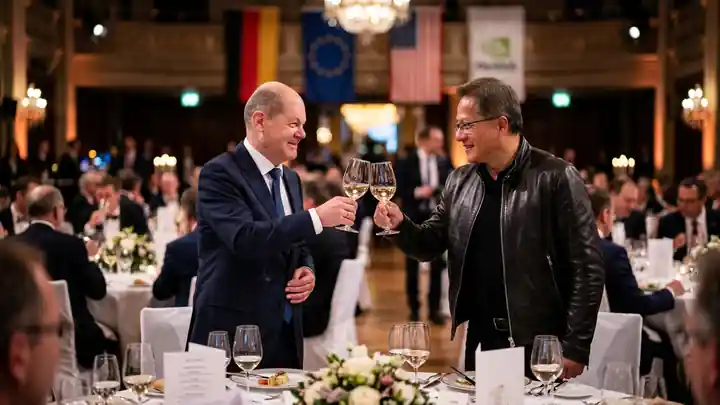
Europe’s largest economy has spent a decade watching the digital revolution happen elsewhere, American chips, American platforms, Chinese manufacturing speed, and wondering when its turn comes. This week Berlin decided to answer with a chequebook and a handshake, in front of two hundred of the world’s business leaders, and the story behind that photo of a German chancellor and a chip CEO raising glasses is bigger than either man. It is Germany betting its industrial future on the technology that eats industries.
Here is what was actually announced, what it means for the German economy, the honest reasons for scepticism, and why the ripple reaches as far as a software graduate in Lahore.
What Was Announced in Berlin
The Invest in Germany Summit brought around 200 business leaders to Berlin, and the centrepiece was a strategic cooperation between the German government, Nvidia, and a group of German companies to build artificial intelligence capacity for German industry. The project includes a significant investment by Germany in powerful Nvidia chips, industrial AI infrastructure aimed squarely at the country’s manufacturing backbone.
Nvidia, for its part, named the four German startups it plans to back, Agile Robots, which builds AI powered robots for manufacturing, logistics and healthcare, Avelios Medical, which develops AI hospital management software, Mirelo, which creates AI generated audio for video, and Reflex Aerospace, which designs and builds satellites. The sizes were not disclosed, but the investments fall under the company’s nearly 10 billion dollar commitment to Europe’s AI ecosystem, announced at the summit. Siemens, Germany’s industrial champion, announced a wider partnership with the chipmaker to advance AI driven autonomous factories, the technology that could define the next decade of manufacturing.
The Berlin deal sheet
Partnership: German government, Nvidia, German industry
Nvidia startups backed: Agile Robots, Avelios Medical, Mirelo, Reflex Aerospace
Umbrella commitment: nearly 10 billion dollars for European AI
Siemens: wider partnership for AI driven autonomous factories
Government: significant investment in high end Nvidia chips
Merz’s Pitch: Open Your Doors for AI
Chancellor Merz’s message to Germany’s famous small and medium enterprises, the Mittelstand that powers the economy, was blunt by his standards. Open your doors for AI, he urged, and make use of your data. The plea reveals the diagnosis behind the summit. German industry is world class at machines and notoriously slow at software, and the country’s business culture, consensus driven, risk averse, process loving, has historically treated data as a compliance burden rather than a fuel source.
The timing is not accidental. Germany spent two years as the sick man of Europe, shrinking through 2023 and 2024 while energy prices bit and Chinese competition hollowed out its car industry, and the first green shoots of recovery have only recently appeared, enough for the Bundesbank president to speak of longer lasting growth potential and for the IMF to raise its 2026 German growth forecast to 1.3 percent. Merz’s government, in office since May, has staked its economic story on reindustrialisation, a 500 billion euro infrastructure fund passed earlier this year, deregulation talks with Brussels, and now the AI card, played with a decoder ring of tax incentives and state backed compute.
The toast with Jensen Huang was the image the summit was built to produce, Berlin signaling to every boardroom in the country that the era of treating AI as California’s hobby is over.
Why Germany Needs This to Work
The stakes sit in numbers that officials rarely say out loud. German businesses are estimated to have invested around 470 billion euros less than expected since 2020, an investment shortfall near 420 billion euros despite government programmes. The car industry, the employment spine of the south, is cutting tens of thousands of jobs as electric transition and Chinese competition squeeze combustion era profits. And the demographics are unforgiving, the German Economic Institute estimates an average shortage of more than 148,000 skilled workers in occupations tied to infrastructure, digitalisation and the energy transition, precisely the technical trades and engineering roles an AI augmented factory either automates or supercharges.
This is why the Nvidia partnership matters beyond the photo. Industrial AI, autonomous factories, AI hospital software, satellite AI, is the rare upgrade path that could raise German productivity without requiring a German cultural revolution in work habits. If the Mittelstand can rent AI capability the way it once rented electricity, the country’s comparative advantage in precision engineering could extend another generation. If it cannot, Germany becomes a museum of excellent manufacturing with a shrinking share of the value added.
The sceptics’ file is honest too. Europe has hosted a hundred such summits, and capital still flows to American AI at ten times the European rate. Nvidia’s investments in four startups, while symbolically rich, are rounding errors against the company’s American buildout. Energy, Germany’s industrial curse of the past three years, remains expensive even after policy relief this autumn, and AI compute is an energy hog. And the talent question is acute, which is where this story touches our part of the world.
The Talent Angle: Why This Reaches South Asia
Germany’s shortage of 148,000 skilled workers is not a German secret, it is a global job advertisement, and the country has spent recent years loosening its skilled immigration rules precisely because its own demographic maths cannot close the gap. For engineers, electricians, IT specialists and healthcare technologists in Pakistan, the pipeline runs through the official skilled worker visa routes, language training and recognised qualifications, and demand has never been higher.
The AI push sharpens the paradox we covered in the UK visa crisis report, where compliance tightening shrank one door for students just as Germany’s labour market flings another for workers. European economies are learning, separately and unevenly, that their natives cannot staff their ambitions, and every summit like Berlin’s quietly advertises that fact to Karachi, Lahore and Dhaka. The graduates who position themselves, German language, recognised credentials, AI adjacent skills, will find that the toast between a chancellor and a chip CEO was, in a very real sense, an invitation.
There is also an industrial policy lesson for Islamabad’s own tech export ambitions, that the countries winning the AI manufacturing layer are the ones signing supply side deals with the chipmakers, not the ones writing strategy papers. Hardware partnerships beat presentations.
The Politics Around the Celebration
Merz needed this week’s good news, and not only for economic reasons. The chancellor’s coalition has been battered by state election results in the east, where the far right AfD’s surges have raised the real possibility of the first far right led regional government in the federal republic’s history in Saxony Anhalt, an outcome migrant organisations have already petitioned the federal government to prepare safeguards against. Rumours of chancellor retirements circulate in Berlin’s gossip economy whenever his party stumbles, and his counter strategy has been to occupy the competence lane, economy, security, and Europe.
The Nvidia summit is competence politics in its purest form, jobs and future arriving in the same frame as the chancellor’s grin, a contrast to the opposition’s culture war headlines. Whether voters trade anxiety for ambition in the next federal round is the open question, but the government will spend the coming months making sure the Berlin announcements appear in every jobs statistic and every factory groundbreaking they can attach them to.
The German government publishes its economic and summit communications through its official English portal, and we will track whether the 10 billion dollar European commitment converts into German steel, servers and salaries.
What Happens Next
Three markers will tell whether the summit was a turning point or a photocall. The first GPU deliveries and where they physically land, because chips on the ground beat chips on paper. Whether German Mittelstand firms actually sign up for the industrial AI programmes, measured in participation numbers the government will be tempted to publish early. And whether the four backed startups, a robotics firm, a health software firm, an audio AI firm and a satellite builder, raise follow on rounds inside Germany rather than relocating to the United States, the traditional destiny of European deep tech ambitions.
We will update this page as the partnership’s first milestones land, because the difference between a toast and a transformation is always in the follow through.
The Worker Question Behind the Money
Strip the summit to its skeleton and one number explains it, the 148,000 unfilled skilled positions in the occupations the fund is meant to rebuild. Germany’s infrastructure renaissance will be built by electricians, grid engineers, software technicians and train drivers the country currently does not have, which is why the chancellor’s immigration politics are now in open tension with his infrastructure politics. Industry associations have begged for faster recognition of foreign qualifications, faster visa processing and a public tone that does not scare away the workers the economy needs, and the IW study’s arithmetic gives them a fresh weapon.
The contrast with Britain’s tightening is instructive for our readers who track both systems. While Germany debates how to attract more foreign talent to run its grid and its factories, the United Kingdom has spent the year shrinking its international student and worker intake, a policy recalibration we documented in detail in our report on the UK student visa crisis for Pakistani applicants, where withdrawal rates and tightened maintenance rules have redrawn the map for South Asian students. Two European economies, two opposite answers to the same demographic arithmetic, and the next decade’s growth statistics will grade both papers.
For Pakistani engineers, IT workers and healthcare professionals reading this, the practical signal is that Germany’s door, whatever the political noise, is being structurally widened by money, with the federal government’s own portal carrying the skilled worker routes and recognition processes that matter more than any headline. Watch the implementation rules of the infrastructure fund for the hiring quotas and qualification programmes buried inside them, because that is where the real immigration policy will live.
Frequently Asked Questions
The Summit
What did Germany and Nvidia announce?
A strategic cooperation between the German government, Nvidia and German companies to build AI capacity for German industry, including significant German investment in high end Nvidia chips, announced at the Invest in Germany Summit in Berlin with Chancellor Merz and Nvidia CEO Jensen Huang on stage together.
Which German startups is Nvidia investing in?
Four were named at the summit, Agile Robots for AI powered manufacturing and healthcare robotics, Avelios Medical for AI hospital software, Mirelo for AI generated video audio, and Reflex Aerospace for satellite design. The investments fall under Nvidia’s nearly 10 billion dollar European AI commitment.
What did Siemens announce?
A wider partnership with Nvidia to advance AI driven autonomous factories, a signal that Germany’s largest industrial company intends to automate its next production generation with the same chipmaker powering the state’s AI infrastructure.
Context and Impact
Why does Germany need Nvidia?
German industry carries a 420 billion euro investment shortfall against pre 2020 trends, a shrinking car sector, and a shortage of more than 148,000 skilled workers in technical trades, and industrial AI is the upgrade path that could restore productivity growth without mass hiring it cannot find.
Does this create opportunities for Pakistani engineers?
Indirectly but really. Germany’s technical labour shortage, already driving its skilled worker immigration policy, intensifies as AI projects scale, and Pakistani engineers and IT specialists with German language skills and recognised credentials are positioned for the demand the summit advertises.
Is 10 billion dollars for European AI a lot?
It is significant by European standards and modest against American AI buildout, which is precisely the gap Berlin hopes partnerships like this begin to close by anchoring chip supply and startup capital on European soil.