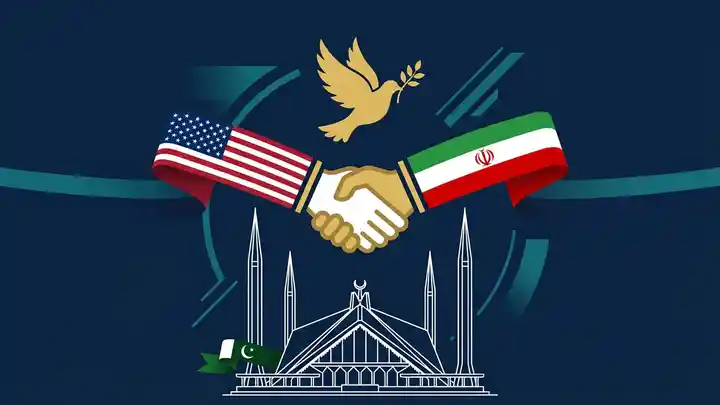

The Islamabad Memorandum of Understanding is back at the centre of world politics, and Pakistanis are searching for it in droves. Google Trends in Pakistan shows “the Islamabad MoU” among the country’s top rising searches over the past day, with more than 5,000 searches, and the reason is serious: with the United States and Iran again trading threats, four major regional powers have publicly thrown their weight behind the peace framework that Pakistan brokered in June. Here is what the agreement actually says, who signed it, why it is trending again, and what happens next if it collapses.
The Islamabad Memorandum of Understanding between the United States of America and the Islamic Republic of Iran was signed on June 17, 2026, at the end of a war that began in February, when American and Israeli strikes opened the conflict that rattled global energy markets for months. Pakistan served as the primary mediator, with Saudi Arabia, Turkey, Qatar and Egypt facilitating. Prime Minister Shehbaz Sharif signed the document as the mediating head of government, after President Donald Trump and Iranian President Masoud Pezeshkian approved it through electronic signatures. It was an extraordinary diplomatic moment: a fourteen-point interim peace agreement, named after the capital of the country that brokered it.
What the Islamabad MoU Actually Agreed
The negotiating teams read like a cast list of the region’s power brokers. The United States sent Vice President JD Vance, special envoy Jared Kushner and negotiator Steve Witkoff. Iran dispatched Speaker Mohammad Bagher Ghalibaf and Foreign Minister Abbas Araghchi. Pakistan’s side was led by Prime Minister Shehbaz Sharif and, notably, Field Marshal Asim Munir, whose back-channel meetings with both capitals were widely credited with keeping the talks alive when they repeatedly seemed dead. Pakistan’s Foreign Office has since confirmed the MoU remains “in place” and that Pakistan stands ready to help again if asked, while noting that both sides have shared seven points for a possible next phase, some of which match the original text.
Why the Islamabad MoU Is Trending Again in October
Because the peace it delivered is fraying. On Friday, October 24, Pakistan, Turkey, Saudi Arabia and Egypt publicly backed the Islamabad Memorandum, part of an intensifying diplomatic push by regional and European capitals to avert a fresh escalation in the Gulf. The statement of support landed in the same week that American intelligence warned Iranian preparations to attack US personnel abroad have reached, in the words of officials briefed on the material, advanced stages. Washington has begun evacuating embassies and military outposts across the Middle East. President Trump is reportedly leaning toward a forceful response, with US war reporting suggesting a resumption of hostilities could come as early as November. Tehran, for its part, has vowed what its officials called an apocalyptic war if America strikes again, while declaring that US warships will not be allowed to enter the Persian Gulf.
Into that powder keg, the four-power endorsement of the Islamabad MoU is a signal, and a deliberate one: the countries that helped end the war are telling both capitals that the framework still exists, still has regional backing, and should not be discarded. Pakistan’s own diplomatic tempo has matched the moment. President Asif Ali Zardari publicly urged both governments earlier this month to honour their commitments under the agreement. And on October 20, Pakistan’s army chief travelled to Tehran for talks that analysts read as a last round of quiet persuasion before the situation tips.
How the June War Ended: A 60-Second Timeline
Understanding why the MoU matters requires remembering how fast the war it ended moved. American and Israeli strikes opened the conflict in February 2026, after weeks of escalation over Iran’s nuclear programme. Iran answered with missile salvos and a campaign against shipping that closed the Strait of Hormuz for stretches, sending oil and insurance rates to levels that had import-dependent economies from Islamabad to Tokyo recalculating their year. Mediation attempts bounced between capitals for months before Pakistan assembled the package that became the Islamabad Memorandum: a negotiating table in a Muslim capital acceptable to both Washington and Tehran, a phased sequence that let each side claim sequence victory, and guarantors with weight in both camps. When Trump and Pezeshkian approved the text electronically and Shehbaz Sharif signed as mediator on June 17, the war’s active phase ended within days, in the sequence the document prescribed.
Why This Matters for Pakistan
The Islamabad MoU is the most consequential piece of diplomacy Pakistan has brokered in decades, and its survival is now tied to the country’s own credibility. If the framework collapses and the Gulf slides back into war, Pakistan sits on the wrong side of every consequence: it imports Iranian-adjacent energy exposure through the region’s shipping lanes, it hosts millions whose remittances depend on Gulf economies, and it borders a Iran that would enter any new fighting under far greater pressure than before. If the framework holds, Pakistan cements its role as the indispensable mediator between Washington and Tehran, a position no other capital currently occupies. That is why the Foreign Office has repeated, briefing after briefing, that the MoU is the basic foundation and that the seven points now on the table build on what was already agreed in Islamabad in June.
The wider diplomatic chessboard is moving too. Russia’s ceasefire experiment around occupied Oleshky in Ukraine, which we tracked from announcement to first violations, has shown how fragile brokered truces are when the political will behind them thins. The Islamabad MoU faces the same physics, with higher stakes: the strait it reopened carries the energy that the world’s inflation calculations, and Pakistan’s own import bill, depend on.
The Seven Points: What We Know and Do Not
Pakistan’s Foreign Office has confirmed that the United States and Iran have each shared seven points for taking the process forward, that the American view has been communicated, and that direct communication between the two sides exists as a result of mediation. What no briefing has published is the text itself, of either the seven points or the full MoU annexes. What is known from the June framework and subsequent readouts: the blockade lift, the Hormuz reopening and the phased asset release formed the first tier; the nuclear negotiations formed the second; and the enforcement mechanics, who verifies what and on what timeline, remain the dispute that keeps bringing the two sides to the brink. Any next-phase agreement would need to answer that enforcement question, and neither capital has shown its hand publicly.
The playbook has one more chapter to write, and Pakistan’s diplomats know the history they are racing. Every interim peace framework lives or dies on its enforcement calendar, and the MoU’s calendar has been honoured loosely at best: the blockade lift became a blockade in a different name, the asset releases slipped their windows, and the nuclear talks the document scheduled have not produced the headline agreement either capital wanted. What has kept the peace is that neither side has wanted to be the one that killed the document. The four-power statement of October 24 is designed to keep it that way, by raising the diplomatic price of walking away. In the coming days, watch for three markers: whether a venue for the seven-point talks is announced, whether American evacuation orders begin reversing, and whether the guarantors put a date on a ministerial meeting. Any one of the three would be the strongest signal yet that the Islamabad framework survives its hardest test.
It is worth being honest about what makes this document different from the region’s long graveyard of failed understandings. Previous truces in this conflict were bilateral and brittle, negotiated between the fighters themselves and abandoned the first time one side smelled advantage. The Islamabad Memorandum is multilateral by design: five Muslim-majority guarantors with real leverage in both capitals, an American administration that invested presidential prestige in the signing, and an Iranian government whose domestic credibility is now partly staked on the deal having delivered the blockade’s end and the promise of released funds. Documents with that many fingerprints on them are harder to discard quietly. They are also harder to amend quickly, which is exactly the tension playing out in the seven points now under negotiation.
What Happens Next: Three Scenarios
For readers following America’s parallel political turbulence, the White House’s willingness to strike is entangled with its own calendar: as our US midterm elections preview detailed, November 3 is nine days away, and every foreign-policy decision now carries a domestic price tag attached. Washington denies the linkage; the timing talks anyway.
Frequently Asked Questions
What is the Islamabad MoU?
The Islamabad Memorandum of Understanding is the fourteen-point interim peace agreement between the United States and Iran signed on June 17, 2026, brokered primarily by Pakistan with Saudi Arabia, Turkey, Qatar and Egypt facilitating. It reopened the Strait of Hormuz, committed America to lifting its naval blockade within 30 days, and set phased release of about $24 billion in frozen Iranian funds alongside further nuclear talks.
Who signed the Islamabad Memorandum?
US President Donald Trump and Iranian President Masoud Pezeshkian were the signatory principals, with Prime Minister Shehbaz Sharif signing as the brokering mediator. The negotiation teams included JD Vance, Jared Kushner and Steve Witkoff for Washington, and Mohammad Bagher Ghalibaf with Foreign Minister Abbas Araghchi for Tehran.
Why is the Islamabad MoU trending in Pakistan?
Because on October 24, Pakistan, Turkey, Saudi Arabia and Egypt publicly endorsed the agreement as US-Iran tensions surged, with American outposts being evacuated and reports that Washington is weighing new strikes. Pakistanis are searching to understand the deal their country brokered and whether the peace will hold.
Is the Islamabad MoU still in force?
Pakistan’s Foreign Office says yes, describing it as the basic foundation of the process, though enforcement has been shaky: the US continues blockade operations Iran calls a violation, and direct talks have stalled. Both sides have exchanged seven points for a possible next phase.
Could the US-Iran war restart?
US war reporting says President Trump is leaning toward a forceful option and that fighting could resume as early as November, while Iran threatens massive retaliation. The regional diplomatic push behind the Islamabad MoU, and the evacuations on the American side, show both governments are seriously preparing for that possibility, which is precisely why the mediators have gone public.
Blazinginfo will keep tracking the Islamabad MoU story as it develops. For Pakistan’s other delicate diplomatic file, see our report on Khalilzad’s arming-the-Afghans claim and Islamabad’s rebuttal, and for the region’s other frozen conflict, our coverage of the Oleshky ceasefire experiment. Details in this report were cross-checked against Pakistan’s Foreign Office briefing of October 23 and regional diplomatic readouts.