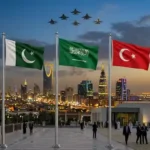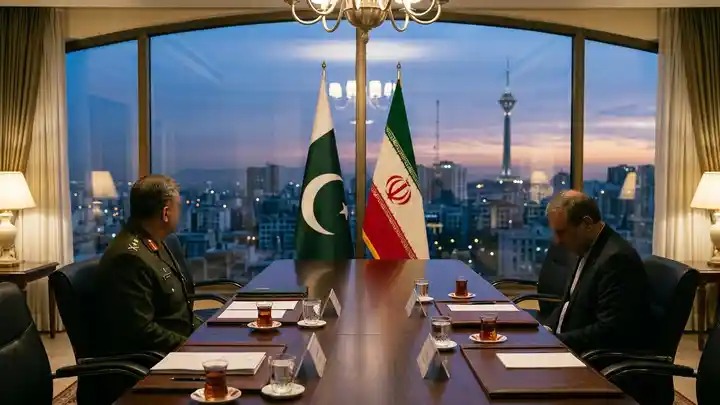

Field Marshal Asim Munir is in Tehran again, and this time he did not come alone in spirit. On Monday, the Pakistani army chief sat across from Iranian President Masoud Pezeshkian alongside the defence minister of Saudi Arabia, Prince Khalid bin Salman, and Turkiye’s intelligence chief Ibrahim Kalin, the first high-level contact between Iran and all three members of the Makkah Defence Alliance since the kingdom was pulled directly into the regional conflict. Iran’s own Foreign Ministry has credited Munir with proposing this meeting during his visit to Tehran just last week, which makes today’s session, by Tehran’s own account, a Pakistani idea brought to life. What did Pakistan’s most powerful soldier carry into the room, what did Iran tell him last time, and why is one general now trusted by both the camp that defends Saudi Arabia and the government it defends against? Here is the full picture.
Who Is at the Table in Tehran Today
The format itself is the news. Since Saudi Arabia became a direct pressure point in the wider conflict through the Houthi campaign, the three Makkah pact signatories and Iran had communicated only through statements and intermediaries. Putting the alliance’s top military and intelligence officials in the same Tehran room as Iran’s president, at Iran’s invitation, marks a structural shift: the region’s newest defence bloc and its principal target of rhetoric are now talking face to face, with Pakistan holding the door open.
The Proposal: How Munir Built Today’s Meeting in One Week
The sequence matters. Last Tuesday, Munir flew to Tehran with Interior Minister Mohsin Naqvi for what Iran’s parliamentary sources initially described as a routine bilateral and border cooperation visit. It was anything but. Over two days he met President Pezeshkian, Foreign Minister Abbas Araghchi, parliament speaker and chief negotiator Mohammad Bagher Ghalibaf, and SNSC secretary Rezaei. According to Iranian officials quoted afterwards, it was in those sessions that Munir floated the idea of a joint meeting between Iran and senior representatives of the three Makkah alliance countries, and Iran’s Foreign Ministry has since publicly acknowledged the proposal as his. By Thursday the Iranians had announced the visiting delegations; by Monday the delegations were in the room.
For context, this was Munir’s second trip to Iran within a week and roughly his fifth since the ceasefire Islamabad helped negotiate, a travel rhythm no other foreign official comes close to matching. Tehran’s hardliners complained that previous mediator visits had lowered oil prices without producing progress, and even Iranian media noted that his latest trip was only finalised on Monday afternoon as crude approached $110 a barrel, the implication being that Tehran sees value in the photo as much as the diplomacy. Islamabad’s view is simpler and it is the one the Foreign Office has repeated for months: the Islamabad MoU remains the basic foundation, some points now under discussion align with it, and the only way out of the spiral is through the table Munir keeps walking to.
What Iran Told Munir Last Week: The Hard Answers
If last week’s visit proved anything, it is that Tehran is not in a conceding mood. In meeting after meeting, Iranian leaders delivered the same three messages, and they matter for judging what today’s four-way session can realistically produce.
Against that wall, Munir carried one concrete idea that has quietly gained traction. Al-Araby Al-Jadeed reported that Pakistan and Qatar jointly proposed giving Iran interest accrued on roughly $6 billion of its frozen assets held in Qatari banks, in exchange for verified access to its nuclear facilities, with Washington’s approval claimed and Iran responding positively. Munir was said to have conveyed the proposal during his meetings. It is exactly the kind of face-saving, trust-building mechanic the moment requires: money Iran can bank without losing face, inspections Washington can verify without capitulation, and mediators who are not the Americans carrying the paper.
The Message Nobody Publicised: Munir on the Houthis and Saudi Arabia
Pakistani officials confirmed to Anadolu that a core purpose of last week’s visit sat outside the US-Iran file entirely. Munir urged the Iranian leadership to use its influence over Yemen’s Houthis to halt the missile and drone attacks on Saudi Arabia, explaining, in the source’s words, Pakistan’s commitment to defend the kingdom under the Mecca defence pact. That sentence deserves a slow read, because it is the entire architecture of Pakistan’s position compressed into one talking point: Islamabad told Tehran, to its face, that it will honour its treaty obligations to Riyadh, and asked Tehran to make those obligations easier to keep by reining in its allies.
Pakistan has drawn the corollary line just as clearly. Its forces in Saudi Arabia, estimated publicly at between 30,000 and 40,000, will defend the kingdom’s territory and will not cross into Yemen offensively. Tehran has absorbed this: rather than breaking with Islamabad over the pact, Iran invited the pact’s representatives to Tehran, and its state media now praises Munir’s mediating role. Iran has even extended invitations for Saudi, Pakistani and Turkish officials to hold regional security talks in Tehran, which is the process today’s meeting formalises. Our detailed report on the Makkah Pact ratification and its NATO-style clauses explains the treaty machinery that puts Pakistani troops inside this equation, and our coverage of the Houthi attacks and Saudi economic fallout tracks the campaign behind it.
Why Only Pakistan Can Sit at Both Tables
The strangest and most consequential fact of this diplomacy is Munir’s own CV: he is simultaneously a treaty ally of Saudi Arabia under a pact whose activation was aimed at Iran-aligned attacks, and the trusted intermediary of a Tehran that barely speaks to Washington. Both sides have reasons to accept the contradiction. Iran needs a channel to the Americans and to the Gulf that does not look like surrender, and Pakistan’s military-to-military relationships let messages travel without ambassadors or press conferences. Riyadh and Ankara need an Iran channel that is not Washington’s, because the Houthi war is being fought on their soil while their American partner focuses elsewhere. Pakistan, holding the June framework both sides still formally reference, is the only capital with credibility at both ends of the corridor.
The Foreign Office has kept the legal ground carefully prepared throughout. It confirmed the Islamabad MoU remains in place, noted that Iran’s seven-day plan and the seven points under discussion align with it, and has consistently described Pakistan’s role as facilitating direct communication rather than imposing terms. That wording preserves the one thing both belligerents still accept: a Pakistani-brokered framework as the reference point for any restart.
The Regional Flurry Around the Visit
Today’s session did not happen in silence; it capped ten days of frantic movement. Russian Foreign Minister Sergei Lavrov met Pezeshkian and Araghchi in Tehran the day before Munir’s first arrival. US War Secretary Pete Hegseth made an unannounced trip to Israel in the same window, while Washington maintained its naval blockade and evacuation posture we covered as oil surged past $114. A Qatari delegation landed in Tehran after Munir’s departure last week, extending the relay of visitors. Oil’s march toward $110 formed the drumbeat under all of it, with Iran’s own Fars agency tying the timing of Munir’s visit to the price spike. And on the American political calendar, the November midterms we previewed here keep the pressure high on a White House that cannot afford either a war or an obvious capitulation, which is precisely why the quiet Pakistani channel keeps getting dialled.
What Happens Next: Three Realistic Markers
Frequently Asked Questions
Why is Asim Munir visiting Iran?
He is carrying Pakistan’s mediation file: ways to resume stalled US-Iran talks anchored to the Islamabad Memorandum, a joint Pakistan-Qatar proposal on Iran’s frozen assets, and a direct request that Iran restrain the Houthis from attacking Saudi Arabia, which Pakistan is treaty-bound to help defend.
Did Pakistan propose the Iran-Saudi-Turkey meeting in Tehran?
Yes. Iran’s Foreign Ministry credited Field Marshal Munir with proposing the joint meeting during his visit to Tehran last week, and a senior Iranian official told Reuters the meeting was initiated by Pakistan. It brought together all three Makkah Defence Alliance members and Iran for the first time.
Who accompanied Munir to Tehran?
Interior Minister Mohsin Naqvi accompanied him with a delegation of officials, according to Pakistan’s military statement and Iranian state media. He met President Pezeshkian, Foreign Minister Araghchi, parliament speaker Ghalibaf and SNSC secretary Rezaei across his visits.
What did Iran tell Munir about negotiations with the US?
Iranian leaders said no talks resume until Washington ends the blockade, lifts oil sanctions and stops regional hostilities, insisted that no enriched uranium will leave Iran, and pointed to the Islamabad MoU and Tehran’s seven-point proposal as the acceptable starting framework.
How many times has Munir visited Iran?
His latest trip, followed by today’s joint session, marked roughly the fifth visit since the April ceasefire that Islamabad helped broker, a frequency that makes him the most frequent high-level foreign visitor to Tehran in 2026.
Blazinginfo will track the outcomes of today’s four-way session and any resumed talks under the Islamabad framework. For the treaty pulling Pakistan into Gulf security, read our report on the Makkah Pact ratification, and for the peace deal Pakistan brokered that both sides still cite, see our explainer on the Islamabad MoU and its regional backing. Details were cross-checked against Pakistan’s Foreign Office briefings and wire reporting from Tehran.