
Last updated: 23 October 2026, 5:45 PM PKT. Verified against Israeli military statements and reports from Hebron and Jerusalem on Friday.
Quick answer:Israel has placed a cordon around Hebron. barred Palestinian travel across the occupied West Bank after a shooting attack near the city wounded five people on Friday morning. Soldiers killed two gunmen at the scene. The military says a wider counterterrorism operation is under way, with dozens of arrests. weapons seizures reported across the territory this week.
The occupied West Bank has entered one of its tightest closures in months. Timing makes it heavier. A shooting near Hebron, the lockdown that followed and a national election four days away all fold into each other. Here is what is confirmed, what it means for the territory, and why this week matters beyond one road junction.
What Happened Near Hebron on Friday
The attack came at first light. Two armed Palestinian men opened fire near a checkpoint north of Hebron, in the southern occupied West Bank. Israeli forces at the scene exchanged fire and shot both gunmen dead. The military said the men carried an M16 rifle and a handgun. Medics took five wounded people for treatment, and officials described some of the injuries as critical.
Within hours, the Prime Minister’s office announced that it had instructed the army to close the occupied West Bank. Netanyahu announced a cordon on Hebron itself, barring Palestinian travel across the territory. Such general closures freeze movement between cities, cut off workers from jobs and tighten an already restricted map. They are among the most consequential steps Israel can take short of a full scale invasion.
The Military Operation Now Under Way
The army and border police have launched a counterterrorism operation across the Hebron area. According to the military, dozens of operations across the West Bank over the past week led to the arrest of around seventy wanted individuals, including members of Hamas. Islamic Jihad. The same statements list weapons recovered, including M16 rifles, Carlo style submachine guns and explosive devices.
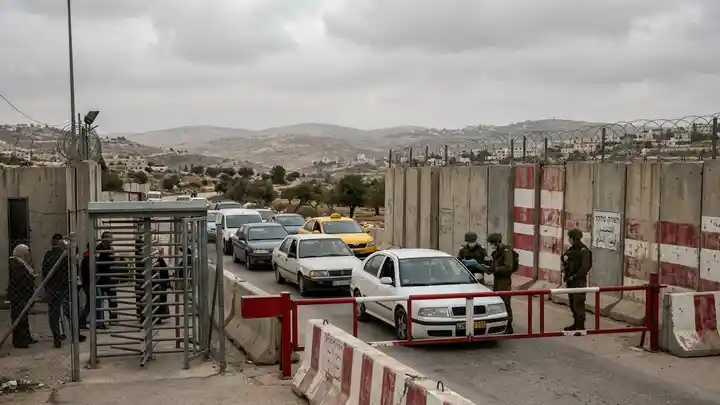
Manhunt roadblocks went up around the junction area on Friday as troops searched for any accomplices. Residents of Hebron reported intensified checks at the city’s entrances. For Palestinians, a closure of this kind means the separation between north and south of the territory hardens overnight, permits become useless at the checkpoints. daily life contracts to the local street.
Why This Week Is Different: The Election
Israelis vote on Tuesday, and the campaign’s final weekend is unfolding against this backdrop. Security events in the occupied territory always shape the closing argument of Israeli elections. parties across the spectrum now compete to promise harder measures. The closure announced on Friday will be dissected in every weekend panel and every rally before polls open.
The vote itself carries regional weight. We set out the stakes and the mechanics in our separate report on theIsrael election and Netanyahu’s bid for another term. Whatever government emerges next week inherits the West Bank exactly as Friday left it, locked, tense and waiting.
The Wider Regional Frame
This is not happening in isolation. Gaza continues to receive Israeli strikes, and residents there report shortages of basic goods including bread. The confrontation with Iran keeps the whole region on alert, which we track in our rolling report on theIran US standoff over the Strait of Hormuz. Saudi Arabia’s security repositioning adds another layer, covered in our story on theHouthi attacks and the postponed Riyadh summit.
In this environment, every incident travels fast. News of the Hebron shooting travelled in the charged language of the conflict within minutes. Responses followed within hours. The escalation ladder in the West Bank has fewer rungs than before. each side climbs it while watching the same election clock.
What a General Closure Means on the Ground
For readers unfamiliar with the territory’s mechanics, a general closure is exactly what it sounds like. Palestinian movement between cities and villages is barred or heavily restricted. Labourers who work in Israel or the settlements stay home. Students miss universities. Patients miss appointments. Markets lose their supply lines for days at a time.
Hebron’s cordon adds a second layer for the largest city in the southern West Bank. Entrances close, agricultural routes get blocked, and neighbourhoods near settlements face curfew style restrictions. Past closures have lasted from days to weeks depending on the security assessment. Nobody on either side expects this one to lift before Tuesday’s vote.
The Honest Picture
Friday’s sequence, attack, killings, lockdown, is the West Bank’s grim routine repeating at election speed. Wounded men will recover or not, the closure will bite, the operation will grind through villages. the vote will pass. What remains unchanged is the territory itself, occupied, fragmented and out of any story that ends soon. Both peoples are trapped in a calendar where security events and elections feed each other. this weekend is the clearest example in months.
Official Israeli military statements are published through theIDF English site. We will update this report as the closure’s length becomes clear and as the election approaches.
Life in Hebron Under a Cordon
Hebron is the West Bank’s most loaded city, and closures there hit differently. The old city hosts the Tomb of the Patriarchs shrine, split between a mosque and a synagogue. Around 800 settlers live in fortified pockets amid a Palestinian population of tens of thousands, protected by some of the densest checkpoint grids in the territory.
A cordon rewrites daily life within hours. Shuhada Street, the main artery, seals first. Workers in the leather and glass workshops south of the old city miss shifts because the route to work adds hours. Students at the university branch face rolling closures of the main junction. Ambulances queue behind concrete blocks. Grocery vans stop arriving, and prices climb quietly at corner shops.
The closure economics bite fastest in Hebron because the city lives on movement. Its markets served the whole southern West Bank. When the checkpoints close, the market closes with them. Vendors who survived previous lockdowns describe the arithmetic simply. One day closed costs a week’s profit. Two weeks closed costs the supplier relationship built over years.
The Election Calendar Collision
The political calendar collides with the security one. Israel votes on Tuesday, four days after the closure began. Security parties are running on the promise of harder hands, and every image of a sealed Hebron feeds that argument. Critics of the government see timing that flatters the campaign. Officials see a standard response protocol that no government would soften before an election.
Palestinian officials watch the same cycle from the other side and read it as theatre paid for in their freedom of movement. That mutual suspicion is the steady state of the territory. What changes week to week is only the intensity. This week the intensity rose on both tracks at once, the security track and the electoral one, and Tuesday’s results will decide how long the elevated tempo holds.
The Economy the Closure Squeezes
Closures are measured in soldiers and checkpoints, but paid for in shekels. The West Bank economy runs on daily movement. Roughly 150,000 Palestinian workers commute into Israel and the settlements on ordinary days, and their wages sustain households across the territory. Each general closure freezes that flow, and each frozen day subtracts directly from family incomes and shop tills.
The arithmetic compounds fast. Estimates from previous lockdowns put the daily cost of a full closure in the tens of millions of dollars for the Palestinian economy. Produce rots at junctions, construction sites idle, and the formal unemployment numbers understate the real damage because most affected workers are informal. Two weeks of closure erases a quarter’s growth in the towns that depend on commuter wages.
Ramallah’s emergency responses follow a familiar playbook, emergency funds for affected families and calls for international pressure. aid agencies top up food distributions. None of it replaces the paycheque. That structural asymmetry, where one side’s security measure is the other side’s economic shock, is why every closure announcement carries consequences far beyond the day’s headlines.
Reading the Signals Before Tuesday
Analysts will watch three signals between now and the vote. The first is duration. A closure lifted within days suggests a security response managed for calm. A closure extended through the election window suggests politics is setting the tempo. The second is the raid tempo. Arrest numbers, home demolitions and settlement expansions each carry their own escalation logic.
The third signal is rhetorical. Watch which ministers visit Hebron for cameras, and which words they choose. Security language aimed at the other bloc signals management. Language aimed at the base signals escalation. Hebron’s residents have learned to read these visits the way harbour towns read barometers.
Whatever Tuesday brings, the territory’s autumn has set its pattern. Tighter closures, faster escalations and a political system that rewards hardness on all sides. The wounded are in hospital, the gunmen are dead, and the calendar keeps moving.
How Closure Rules Actually Work on the Ground
A general closure is not one switch but a stack of permissions. Permit holders for work inside Israel are turned back at checkpoints. Merchant convoys get rerouted through long detours. Students face sealed university roads, and intercity bus lines through the territory get cancelled at their depots. Each layer has its own enforcement rhythm, which is why two neighbouring towns can experience different intensities of the same lockdown.
Exemptions are the machinery’s hidden gear. Medical cases, funeral parties and some agricultural crews move with coordination papers, processed through liaison offices that stay open during closures. The system leaves documented stories of ambulances delayed and births at checkpoints every year. Human rights groups log them. Officials cite the security logic. Both records grow with every lockdown.
Hebron adds its own layer on top. The city’s settler pockets mean Israeli military presence is permanent even in normal weeks, and closure days activate the deeper protocol. Streets that already have gates get locked gates. Shops that already shut early shut at noon. For Hebron’s residents, the difference between tense and closed is measured in whether the gate at the end of the street swings open in the morning.
International reactions have followed their established grooves. Western capitals called for restraint and proportionality. Regional governments condemned the closure framework itself. Washington’s pre election silence was noted in both camps, and none of the statements changed the facts on the ground. Hebron’s morning is set by the district commander, not by communiques.
For readers tracking this story over the next week, the practical markers are simple. When checkpoint queues shorten and merchant permits flow again, the cordon is easing. When raids spread from Hebron to the northern towns, it is widening. The city itself will signal the trend before any official confirms it, and residents read those signals faster than any briefing can publish them.
Frequently Asked Questions
A shooting attack near Hebron on Friday morning wounded five people. Israeli soldiers killed two gunmen at the scene. the Prime Minister ordered a general closure of the West Bank with a special cordon on Hebron.
No end date has been announced. Past general closures have lasted days to weeks. With the Israeli election on Tuesday, analysts expect the measures to remain through the vote at minimum.
A counterterrorism operation is under way in the Hebron area. The army says around seventy wanted men were arrested across the West Bank this week, with rifles, submachine guns. explosives seized.